
Cosmic “Carpe Diem”

carpediem

Carpe diem is a Latin aphorism taken from the Roman poet Horace’s work Odes (23 BC), Book 1. It is usually translated as “Seize the day!” In other words, the past is irretrievably gone, the future is promised to no one, so all we have is the gift of today—of right now—which is why it is called “the present.”

You may recall that the phrase carpe diem was popularized by a character portrayed by the late Robin Williams in the 1989 movie Dead Poets Society. The film was espousing an utterly humanistic worldview, but that doesn’t mean we should discard the power contained in the Latin words. And did you know there is a cosmic carpe diem? It is found in the Psalter; my friend and spiritual father, Dr. D. James Kennedy, would use these words to open the services at Coral Ridge Presbyterian Church every Sunday morning. You knew that church was about to begin when his rich, deep voice would come booming over the public address system, proclaiming the message of Psalm 118:24 —

This is the day the Lord has made; we will rejoice and be glad in it.

Dr. Kennedy would say that he liked to quote this verse aloud when he woke up in the morning; he said it helped him focus on the only moment that is guaranteed in this life: right now!

Scripture has provided us with a word of great encouragement; I believe God is telling us to reflect on the moment at hand and seize it for the glory of God by rejoicing and being for this time that God has given us. The time to rejoice and be glad in the Lord is now . . . not tomorrow, because none of us knows what tomorrow will bring.

So let me ask you: How well have you been doing at “seizing the day” lately? Far too many people spend far too much time living in some unforgiven past, which paralyzes them and keeps them from seizing today . . . and robs them of any ability to rejoice and be glad in this present day.

If this describes you, here is what you need to remember: Jesus paid for your past through His sinless life, His sacrificial death, and His supernatural resurrection. You sins—no matter how awful or hurtful they may have been—have been forgiven because they have all been nailed to a cross. As Paul wrote to the Christians at Colosse:

When you were dead in your sins and in the uncircumcision of your sinful nature, God made you alive with Christ. He forgave us all our sins, having canceled the written code, with its regulations, that was against us and that stood opposed to us; he took it away, nailing it to the cross. (Colossians 2:13-14)

All our violations of God’s perfect, holy, and righteous law have been paid for—paid in full—by our loving Lord, who has fully redeemed us from our past transgressions. Psalm 118:24 is a glorious reminder of this truth.

The flip side of living in some unforgiven past is living in some anxiously anticipated future. This too will keep you from rejoicing and being glad in the present moment. If this describes you, here is what you need to remember: Jesus paid for your future through His life, death, and resurrection. Your future has already been forgiven and nailed to cross; once again, Psalm 118:24 is a glorious reminder of this truth.

In other words, there is nothing you can do to mess up your relationship with your Redeemer! You are completely secure in your salvation, but not because of anything you have done or will ever do. You are secure in your salvation because of everything Jesus has done on your behalf. “It is finished,” He declared from Calvary’s cross. And it is! His atoning work on our behalf has been accomplished. We have been set me from our guilt and shame over the past, just as we have been set free from anything that may take place in the future. Psalm 118:24 empowers us to seize the day, regardless of the circumstances we have faced, are currently facing, or may face tomorrow.

We trust Jesus with our past and we trust Jesus with our future, so we can certainly trust Him with our present. Perhaps the best way for you to begin living out this truth is to start your day the same way Dr. Kennedy started his day: by giving voice to this cosmic carpe diem . . .

“Today IS the day the Lord has made; I will rejoice and be glad in it!”

This is the Gospel. This is grace for your race. NEVER FORGET THAT . . . AMEN!

Leave a comment

Filed under General

The Master and His Misfits

misfit toys

Because we are citizens of two kingdoms—the kingdom of God and the kingdom of man—we may very well feel, at times, like we just don’t “fit in.” The reason for this is the fact that both kingdoms operate on totally different value systems; because of this, we can feel like misfits from time to time. This is undoubtedly what the disciples felt when our Lord was crucified. Jesus had warned them:

I tell you the truth, you will weep and mourn while the world rejoices. (John 16:20)

Speaking to His disciples in the upper room on the night He was to be betrayed, Jesus told His disciples that He was about to be put to death, and that death would cause two diametrically opposed responses:

The world would rejoice and the disciples would weep and mourn.

The religious leaders rejoiced because they thought they had finally silenced that troublesome voice that many of the people were listening too. They believed God had vindicated their decision to crucify Jesus, because the Old Testament states that everyone hung on a tree is under God’s curse. Even Jesus Himself seemed to confirm this when He cried out from that cruel cross, “My God, My God, why have you forsaken me?”

Rome was rejoicing because they had removed a potential rabble-rouser from their midst. But while the world rejoiced, the disciples and all those who loved Jesus wept and mourned. They were the Master’s misfits.

Not much has changed after 2000 years. The world still rejoices at the things that make the people of God weep and mourn. The world rejoices when the name of Jesus is blasphemed. The world rejoices when the Law of God is disregarded. The world rejoices when sin is reduced to simply a matter of personal preference and every man does what is right in his own eyes. But the child of God weeps and mourns.

Yet after telling His disciples that they would grieve, Jesus made them a promise:

You will grieve, but your grief will turn to joy. (John 16:20)

When Jesus cried “It is finished!” and gave up His spirit, the world thought it had won a victory. But three days later, the grief of the disciples was turned into joy, because a dead man got up and walked out of His grave. Jesus overcame sin, Satan, and death through His crucifixion and resurrection, and it is this truth that will carry us through everything we are going through on this side of the grave. Jesus promised us that we would have trouble in this world, but He also said He has overcome the world (John 16:33). Our Master has overcome this world for His misfits . . . and that includes you and me!

Remember, weeping may last for a night, but joy comes in the morning (Psalm 30:5).

This is the Gospel. This is grace for your race. NEVER FORGET THAT . . . AMEN!
Leave a comment

Filed under General

Labor Day and Our Lord

labor day

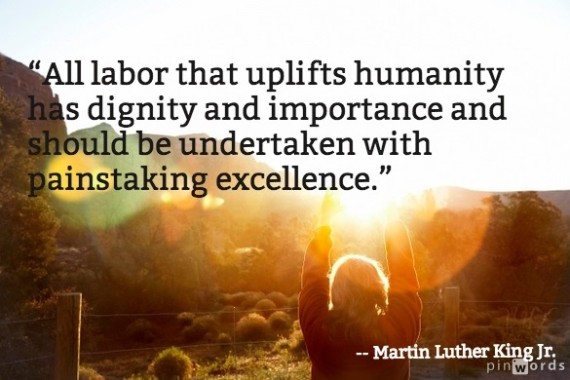
Labor Day is a United States federal holiday observed on the first Monday in September, which is meant to celebrate the economic and social contributions of workers. Today I would like to take a moment to celebrate the contributions of all workers who are busily engaged in building the kingdom of God.

It is important to ask and answer the question, “Who are the kingdom builders?” Is the term reserved only for those who are in full-time vocational service, such as pastors and missionaries? If you have been following our “Grace for the Race” blog for any length of time, you know that the answer to that question is a resounding “NO!”

Here are some profound words on this subject from Os Guinness, written in his book, The Call. This is an extended excerpt, but it is well worth reading and considering.

There is a great distortion which argues that Christ gave two ways of life to his church. One is the perfect life, the other is permitted. The perfect life is spiritual, dedicated to contemplation and reserved for priests, monks, and nuns; the permitted life is secular, dedicated to action and open to such tasks as soldiering, governing, farming, trading, and raising families. Higher vs. lower, sacred vs. secular, perfect vs. permitted, contemplation vs. action. Sadly, this two-tier or double-life view of calling flagrantly perverted biblical teaching by narrowing the sphere of calling and excluding most Christians from its scope. If all that a believer does grows out of faith and is done for the glory of God, then all dualistic distinctions are demolished. There is no higher/lower, sacred/secular, perfect/permitted, contemplative/active, or first class/second class.

Calling is the premise of Christian existence itself. Calling means that everyone, everywhere, and in everything fulfills his or her (secondary) callings in response to God’s (primary) calling. For the Reformers, the peasant and the merchant—for us, the business person, the teacher, the factory worker, and the television anchor—can do God’s work (or fail to do it) just as much as the minister and the missionary.

The recovery of the holistic understanding of calling was dramatic. William Tyndale wrote that if our desire is to please God, pouring water, washing dishes, cobbling shoes, and preaching the Word is all one. William Perkins claimed, “Polishing shoes was s sanctified and holy act and the action of a shepherd in keeping sheep, performed as I have said in his kind, is as good a work before God as is the action of a judge in giving sentence, or of a magistrate in ruling, or a minister in preaching.”

The cultural implications of recovering true calling were explosive. Calling gave to everyday work a dignity and spiritual significance under God that dethroned the primacy of leisure and contemplation. Calling gave to humble people and ordinary tasks an investment of equality that shattered hierarchies and was a vital impulse toward democracy. Calling gave to such practical things as work, thrift, and long-term planning a reinforcement that made them powerfully influential in the rise of modern capitalism. Calling gave to the endeavor to make Christ Lord of every part of life a fresh force that transformed churches and cultures. Calling gave to the idea of “talents” a new meaning, so that they were no longer seen purely as spiritual gifts and graces but as natural and a matter of giftedness in the modern sense of the term.

Calling demanded and inspired the transforming vision of the lordship of Christ expressed in the famous saying of the great Dutch prime minister, Abraham Kuyper: “There is not one square inch of the entire creation about which Jesus Christ does not cry out, ‘This is mine! This belongs to me!’”

WOW! Now that should help us all see the vision and value of calling from God’s perspective. From our first parents in the Garden of Eden, all of life is to be lived coram Deo (before the face of God). It doesn’t matter if one is a butcher, baker, or candlestick maker—or a priest, monk, or nun—every service is sacred when it is lived out in the light of eternity for the glory of God.

So . . . who are the kingdom builders for the King of kings and the Lord of lords? Here is the answer: Everyone who is putting their gifts, talents, and abilities into faithful service in order to glorify God and expand the cause of His kingdom.

This Labor Day, take a moment to do a personal evaluation in the area of your “calling” and ask yourself if there is any sacred/spiritual split. How is your work impacting the kingdom of God? How are you allowing God to use you, right were you currently are, to expand the cause of His kingdom?

So whether you eat or drink or whatever you do, do it all for the glory of God. 1 Corinthians 10:31)

I like to say that there is only one “menial” job in this world: that job is the one where Jesus cannot be found. If you labor as a labor of love for the glory of God, the good of others, and the expansion of God’s kingdom, you can rest assured that what you are doing—regardless of what others might think or say about it—echoes in eternity. Let that truth bless you this Labor Day!

This is the Gospel. This is grace for your race. NEVER FORGET THAT . . . AMEN!

Leave a comment

Filed under General

Liberty with Limits

boundaries

The Good News of the Gospel proclaims unimaginable liberty to us all. We have been liberated from hell. We have been liberated from the stranglehold that sin, Satan, and death once had on us. Tragically, however, many Christians foolishly believe that we are now free to live any way we choose, without any thought for consequences, very much like a teenager hurtling down the highway at twice the speed limit, recklessly confident that no harm will ever come to him or anyone else.

This notion is simply and utterly false! The liberty we enjoy as Christians comes with limits. The Scriptures lay out three classes of inspired instructions for the child of God:

#1. What God has commanded

#2. What God has forbidden

#3. What God neither commands nor forbids

Theologians sometimes refer to the third category— what God neither commands nor forbids—as “things indifferent,” and it is within this category that we must use discernment and prayerfully consider how we are to act. Our liberty must be lived out very carefully in these matters, always taking those within our circle of influence into consideration. Paul cautioned the Christians at Corinth:

Be careful, however, that the exercise of your rights does not become a stumbling block to the weak. For if someone with a weak conscience sees you, with all your knowledge, eating in an idol’s temple, won’t that person be emboldened to eat what is sacrificed to idols? So this weak brother or sister, for whom Christ died, is destroyed by your knowledge. When you sin against them in this way and wound their weak conscience, you sin against Christ. Therefore, if what I eat causes my brother or sister to fall into sin, I will never eat meat again, so that I will not cause them to fall. (1 Corinthians 8:9-13)

The apostle Paul was addressing a significant issue the Corinthians had hotly debated—whether or not to eat meat that has been sacrificed to idols. You’re probably thinking, “So what does that have to do with me? We don’t have that kind of ‘indifferent thing’ to be concerned about today.” That’s true, but we could very well substitute the question of whether or not a Christian should drink alcohol. Alcohol is not forbidden by Scripture; only drunkenness is prohibited. So, in our Christian liberty, we are free to drink a glass of wine with dinner . . . or a snifter of brandy after the meal. But what if we knowingly tempt or offend a weaker brother or sister in Christ by doing so?

Paul knew the Corinthians had the freedom to eat meat offered to idols, but he was careful to remind the “stronger” saints to be conscious of those weaker around them. The bottom line is this: our liberty must never lead another astray. The term for this principle comes under the heading of “The Royal Law of Love,” where our love for others trumps our liberty. The good of our more vulnerable brothers and sisters in the faith should be much more important to us than our liberty, because we are more concerned about contributing to their spiritual health than about exercising our freedom.

Here is a great way of looking at this issue: for the parents of newborn children, it is often the child who determines whether Mom and Dad will enjoy a “date night.” If the baby is sick or visibly terrified about being left with a sitter, the child rules the night and the parents stay home. When this happens, we don’t resent our baby; we simply respond to the child’s needs and go on with life. In the same way, you and I must not resent those around us who would be blessed by a bit of restraint in our lives.

The key is to always look outward, rather than inward, which is the foundation upon which our Gospel liberty has been given to us. Just two chapters later in the same epistle to the Corinthians, Paul said simply: “No one should seek their own good, but the good of others” (1 Corinthians 10:24).

The supreme example, of course, is found in the life of Christ. All liberty was within His possession, yet He laid down His liberty and His very life for us! Our salvation is not about us; it is about Jesus, and we must always be mindful of how we are putting the Gospel on display to a watching world.

As the nineteenth-century English novelist, poet, playwright, and politician, Edward George Bulwer-Lytton, once said, “Love sacrifices all things to bless the thing it loves.” This was the love that our Savior showed us; may this be the consistent confession of our liberated lives!

This is the Gospel. This is grace for your race. NEVER FORGET THAT . . . AMEN!
Leave a comment

Filed under General

Knowing God

knowing god

How well do you know God? The agnostic says that God is unknowable and beyond the reach of the human mind. Well, this simply is not true. God is knowable and you know it . . . and deep down, so does the agnostic.

It was Thomas Huxley, known as “Darwin’s Bulldog” for his advocacy of Charles Darwin’s misguided and mistaken theory of evolution, who coined the term “agnostic” back in the nineteenth century. “Agnostic” comes from two Greek words:

gnosis = to know

a = to take away

In other words, the agnostic believes the knowledge needed to know God has been taken away; it is not available to the human mind. Now, inasmuch as the word agnostic is a relatively new word to the English language, we can find its Greek equivalent throughout sacred Scripture. Here is one example from the pen of the apostle Paul.

I do not want you to be ignorant . . . (Romans 11:25)

The Latin word “ignorant” is derived from the Greek agnoeo, which means “not to know.” So agnostic and ignorant mean the exact same thing: not knowing God!

But you and I know that we can know God, because He has written two books for us to read. The first book comes under the title of General Revelation, consisting of everything we see in the world (cosmos) around us. Deep down, we know there is a God and it is not us! The astronaut Eugene Cernan said, “I am convinced of God by the order out in space.”

The second book God has given us comes under the title of Special Revelation. The Bible is God’s revelation in written form; by looking at both books we can come to a very deep understanding of God. This knowing goes far beyond just knowing about God; this knowing plumbs the depths of really knowing who God is . . . and by knowing who He truly is, we begin to know who we are and what we are here to do.

The best way to get to really know God is to read about Jesus in the Scriptures. Time and time again, Jesus told His disciples that to see Him was to see the Father . . . to hear Him was to hear the Father . . . to know Him was to know the Father. Why? Simply because Jesus was God incarnate. As the great “I AM,” Jesus is the expressed revelation of God in human form. John’s gospel opens with these words, “In the beginning was the Word, and the Word was with God, and the Word was God. . . . No one has ever seen God; the only God, who is at the Father’s side, he has made him known” (John 1:1, 18 ESV).

The more you know about Jesus, the more you will know about God, and the more you know about God, the more you will know about yourself and your place in this world. And by knowing your place in this world, you will experience the three things every human being needs to know to live a life that truly matters: purpose, meaning, and significance. To truly know God is to know all you truly need to know!

This is the Gospel. This is grace for your race. NEVER FORGET THAT . . . AMEN!

Leave a comment

Filed under General

Locusts – Losses – and Our Lord

locusts.jpg

I used to think that all those adult years before Kim and I were saved were simply “lost” years of wasted time. Today I know better. We have a great promise from our good God that every perceived loss in our past will one day be restored.

I will restore to you the years that the swarming locust has eaten, the crawling locust, the consuming locust, and the chewing locust, My great army which I sent among you. You shall eat in plenty and be satisfied, and praise the name of the Lord your God, who has dealt wondrously with you; and My people shall never be put to shame. (Joel 2:25-26 NKJV)

The locust can represent anything in our lives that stood in opposition to our God. Here is what “the prince of preachers,” Dr. Charles Haddon Spurgeon, had to say regarding the locust:

The locust of backsliding, worldliness, and luke-warmness are now viewed by us as a terrible plague. Oh, that they had never come near us! The Lord in mercy has now taken them away, and we are full of zeal to serve Him. Blessed be His name, we can raise such harvests of spiritual graces that they will make our former barrenness disappear. Through rich grace we can turn to account our bitter experience and use it to warn others. We can become the more rooted in humility, childlike dependence, and penitent spirituality by reason of our former shortcomings. If we are the more watchful, zealous, and tender, we will gain by our lamentable losses. The wasted years, by a miracle of love, can be restored.

As you look back over your life, are you troubled by seemingly wasted time? Do you see seasons of scarcity when there should have been abundance . . . perhaps because you neglected opportunities your God set before you? Well, you aren’t alone! The locusts have created losses for all of us. We have all given in to less than God’s best for our lives. But God has promised to restore the years the locusts have eaten; in God’s economy, there is no such thing as “wasted time.” God uses every single moment of our existence to ultimately move us in the direction of our eternal destiny.

In his previous life, the apostle Paul was the great persecutor of the early Christian church. To be sure, he must have seen that time of persecuting the church as worse than wasted years—he had engaged in the ultimate sin, because he was persecuting Jesus Himself by persecuting His church (Acts 9:4). Yet what did God do with those years the locust had eaten? He turned Paul’s misguided zeal for religion into a magnificent obsession for his Redeemer. Paul went from persecutor to preacher; and the rest, as they say, is history.

My prayer for you today is that you will rest in this great promise from our great God. Every loss will ultimately be for your gain. Every missed opportunity will be a stepping stone in the direction of something even greater. Remember, because God is for you, it doesn’t really matter what is against you, even the years the locusts have eaten. Your Redeemer will restore it all!

This is the Gospel. This is grace for your race. NEVER FORGET THAT . . . AMEN!

Leave a comment

Filed under General

Divine Door of Deliverance


Door

In the gospel of John, Jesus makes His seven great “I AM” statements that remind us of His deity and our destiny. I want to present one of them here to give you a word of encouragement today:

I am the door; whoever enters through me will be saved. They will come in and go out, and find pasture. (John 10:9)

Our Lord Jesus Christ is the only entrance into the true church, the true faith, and into right relationship with the One True God. After His proclamation of being the Divine Door of Deliverance, Jesus then gives us two incredible promises.

Promise #1—You Will Be Saved

Whoever enters through the Divine Door will be saved. Notice what Jesus did not say: He didn’t say, “Whoever enters through me by good works will be saved,” or “Whoever enters through me by consistent church attendance will be saved,” or “Whoever enters through me by daily devotions and a consistent prayer life will be saved.” He simply and profoundly said, “Whoever enters through me will be saved!” The saving is His work, not ours. We bring nothing to our salvation but our sin, and Jesus has atoned for it all.

Promise #2—You Will Find Pasture

This promise eliminates any concern for not having any of our needs met. Now, we may and often do find ourselves with many unmet wants. We want a raise or a new car or a bigger house. But we will never be without anything that is needful for this life and the next. Jesus will meet all of His people in their place of deepest need, and they will never be without a pasture in which to graze on God’s Word, behold His glory, and grow in godliness.

In closing, this Divine Door of Deliverance is open to all who will, by grace through faith, transfer their trust from themselves to Jesus. There is no other door that leads to eternal life. When Jesus said He was the only way to the Father in heaven, He meant what He said! You need only believe on Him who is the Divine Door of Deliverance and you will be brought out of darkness and into His wonderful light . . . delivered from death to life.

And to those who are already His, remember that Jesus is the Divine Door for every spiritual blessing each and every day. Come in and go out through Jesus every day and your soul shall be as a fountain that overflows with the waters of both eternal life and everyday life . . . and that life will be abundant!

This is the Gospel. This is grace for your race. NEVER FORGET THAT . . . AMEN!

Leave a comment

Filed under General

No Stunted Saints or Dwarfed Disciples

blog compae

Did you know that the grace that saves us is the same grace that sanctifies us? God’s ultimate goal in your life is to conform you to the image of His beloved Son, so to stay like you were when you were saved is simply not possible. In the Kingdom of God there are no stunted saints or dwarfed disciples. Every child of God is in the process of growing up into Christ. To be sure, some grow faster than others, but we all must grow.

Christ himself gave the apostles, the prophets, the evangelists, the pastors and teachers, to equip his people for works of service, so that the body of Christ may be built up until we all reach unity in the faith and in the knowledge of the Son of God and become mature, attaining to the whole measure of the fullness of Christ. Then we will no longer be infants, tossed back and forth by the waves, and blown here and thereby every wind of teaching and by the cunning and craftiness of people in their deceitful scheming. Instead, speaking the truth in love, we will grow to become in every respect the mature body of him who is the head, that is, Christ. (Ephesians 4:11-15)

Here we have a wonderful promise of guaranteed growth. We start our Christian pilgrimage as infants—babes in Christ. But God does not leave us there! He gives us all the spiritual nourishment we need to grow and mature in our faith until we ultimately reach complete conformity to Christ on the other side of the grave. A “stunted saint” or a “dwarfed disciple” is as much an oxymoron (a phrase that contradicts itself) as a “joyless Christian.”

So . . . are you satisfied with the level of spiritual growth in your life today? It’s important to remember that, unlike our justification (which is wholly a one-way action completed by the Almighty alone) our sanctification is a process we are to participate in. God gives every one of His children numerous means of grace that are designed to grow us and mature us in our faith. God has given us His Word to read, the privilege to pray, and His church to attend. God has provided us with the disciplines of fasting, serving, and watching. God has given us the great honor to worship Him and also to witness for Him. Everything we do for the glory of God is a means of making us mature in our faith.

Hardship is also part of God’s plan for producing holiness in your life. The writer of Hebrews tells us, “Endure hardship as discipline; God is treating you as sons. For what son is not disciplined by his father?” (Hebrews 12:7). In other words, the pain you experience in your life is never without a purpose. The intended end of every providential pain is to conform you to the image and likeness of our Lord Jesus Christ. Even when the pain we experience is a consequence for poor choices, it is never punitive; God’s chastening is always corrective. It is designing to produce healing and growth, not misery and despair.

God loves us too far much to leave us as He found us. So He is growing us up, by any and every means necessary, into Christ by His grace, because God does not give birth to stunted saints or dwarfed disciples!

This is the Gospel. This is grace for your race. NEVER FORGET THAT . . . AMEN!

Leave a comment

Filed under General

Food Of The Faithful

food

So much of life is centered around meals. And who reading this right now doesn’t enjoy a great meal, shared with good friends? God has given us some wonderful things to eat in order to sustain life. But He has also given us something else that needs to be eagerly devoured and thoroughly digested: the Word of God.

When Jesus was just beginning His ministry, He fasted forty days and forty nights in the wilderness. At the end of that time, Satan came to tempt our Lord:

“If you are the Son of God, tell these stones to become bread.” (Matthew 4:3)

Was Jesus hungry? You bet He was hungry! Yes, He is fully God, but He was also fully man, just like you and me. He got thirsty, tired, and hungry. But notice how He responded to this temptation to satisfy His hunger apart from the will of His Father in heaven.

Jesus answered, “It is written: ‘Man shall not live on bread alone, but on every word that comes from the mouth of God.’” (Matthew 4:4)

The food of the faithful is the Word of God. By the Word of God we were created and we are sustained “by the word of his power” (Hebrews 1:3). The Word of God not only sustains life, it strengthens us for the fiery darts that Satan throws our way.

When tempted by the devil to satisfy a normal need that we all have, but in a way God the Father had not commanded, Jesus used God’s Word as a weapon of warfare. Jesus defeated the devil with the Word of God … and we can too!

Without the Word of God, we are like a rudderless ship adrift out on the open ocean; we are at the mercy of the strongest wind that is blowing our way at the time. But armed with the food of the faithful, we are able to withstand gale-force winds that would otherwise drive us onto the rocks.

So here is my challenge for you today: the next time you are eating something, remember the most important food God has given you: His holy, inerrant, inspired, infallible Word. Make the Bible your “go-to-book” and go to it often. Rise with it in the morning and retire with it in the evening. Feast on every word in that Holy Book, knowing that God will sustain you through every storm wind that blows your way, strengthening you for the work He has set before you.

“Man shall not live on bread alone,” but on every word from Genesis to Revelation. As I have said here before, the Book you don’t read won’t help. God could have left it to the Holy Spirit to encourage, inspire, and motivate us to live a life that is pleasing to God. But He did not. He saw to it that His Word was written down so that we would read it. Feast on the food of the faithful, and you will find that the favor of the Almighty will follow you wherever you go!

This is the Gospel. This is grace for your race. NEVER FORGET THAT . . . AMEN!

Leave a comment

Filed under General

The Lord Looked

father and son

Growing up playing sports, I was always greatly encouraged when my parents were looking on during the games. Just knowing that they were watching me was a source of great encouragement, even when my performance was less than I had expected.

Well, there is someone who is looking on in your life and mine, One who provides us with eternal encouragement, and I want to tell you about Him today:

The Lord looked at [Gideon] and said, “Go in this your strength and deliver Israel from the hand of Midian. Have I not sent you?” (Judges 6:14 NASB)

God had called Gideon to deliver Israel from the hands of the Midianites, but Gideon was afraid; he didn’t want to follow the Lord’s leading. But “the Lord looked,” and the fear Gideon was facing fled and His doubt was dismantled. What a look that must have been, a look that encouraged Gideon to rise up and deliver His people from the hands of his enemies!

Notice something else that went along with this look from the Lord. When the Lord looked upon Gideon, He sent him off in the strength of the Almighty. Yes, the Lord said, “Go in this your strength,” but He immediately followed that command with “Have I not sent you?” This clearly indicated that “your strength” meant the strength that God had given Gideon. If God had sent Gideon to deliver Israel in Gideon’s strength, surely he would have never prevailed.

Anytime we are called by God to do His bidding and we “bid” in our own strength, we are sure to fall short of the intended mark. When we go in our strength we actually go in weakness! But when we go in the strength of our Savior, we go in a supernatural strength that has no limits. Know this truth:

Who the Lord sends the Lord strengthens for the sending!

So . . . knowing that the Lord looks upon you day and night—moment by moment—where has He sent you to go? Did you go? And if you did go, did you go in His strength? If you did not go, why? Has fear frozen you? Has doubt debilitated you? Has weakness warped your walk? If that is the case, fear not; you are in the same situation as Gideon . . . until He surrendered control of his life to his God.

It is my prayer for you today that you will, by faith, put to good use the strength your Savior has entrusted to you to go forth and expand the cause of His Kingdom—right now, right where you are. Remember, the Lord looked upon Gideon to strengthen him and He is looking upon you right now . . . to strengthen you, help you, and uphold you.

This is the Gospel. This is grace for your race. NEVER FORGET THAT . . . AMEN!

Leave a comment

Filed under General