It was the first Easter morning. Mary Magdalene went to the tomb, saw the stone had been removed, and went running to Peter and John. When she told them someone had taken the Lord out of the tomb, the two apostles raced to see for themselves. John got to the tomb first and looked in, but Peter went straight into the tomb and saw the strips of linen lying there. Then John entered the tomb, and we read the words of our verse today: “He saw and believed.”
John didn’t see what he thought he would see: the dead body of his Lord. John saw nothing there except the discarded burial cloths; when he saw, the Scriptures tell us, he believed. This was indeed a time when nothing was something! Why? Because for the very first time, the disciple whom Jesus loved was seeing through the eyes of faith. Only when we are looking through the eyes of faith can we see nothing and it becomes something. John saw that the tomb was empty on that first Easter morning, and, by faith, he believed that Jesus had indeed risen from the dead, just as He had said He would do.
In the natural we see so little. For the most part, we live by the phrase, “Seeing is believing!” If we don’t see something, we don’t believe. By nature, we are all just like Thomas, who said, “Unless I see the nail marks in [Jesus’] hands and put my finger where the nails were, and put my hand into his side, I will not believe” (John 20:25). Well, John saw nothing and believed, because John was looking beyond the fleshly veil. John was looking though the eyes of faith, and the eyes of faith are able to see the invisible.
Some 800 years earlier, the armies of Aram surrounded the city of Dothan; when the servant of the prophet Elisha saw them, he was terrified. What he saw was real and true. The city was surrounded by the enemy, but the servant was only looking in the natural. Elisha prayed that the Lord would empower his servant to see through the eyes of faith, and when he did, “He saw the hills full of horses and chariots of fire all around Elisha” (2 Kings 6:17). The servant learned a very valuable lesson that day when Elisha assured him that “Those who are with us are more than those who are with them.”
Only when we are looking through the eyes of faith will we begin to see all that God is doing in our lives. God has surrounded you with legions of angels led by the Lion from the tribe of Judah, and He has promised to protect and provide for your every need. Do not fear what you may be seeing through your physical eyes, for they see only a tiny portion of what is actually going on around you. Ask God to open your eyes of faith, and you will begin seeing God’s hand in everything that is happening in your life. At that level of living, seeing nothing is indeed something!
This is the Gospel. This is grace for your race. NEVER FORGET THAT . . . AMEN!
“Is not my word like a hammer that breaks a rock in pieces?” declares the Lord. (Jeremiah 23:29)
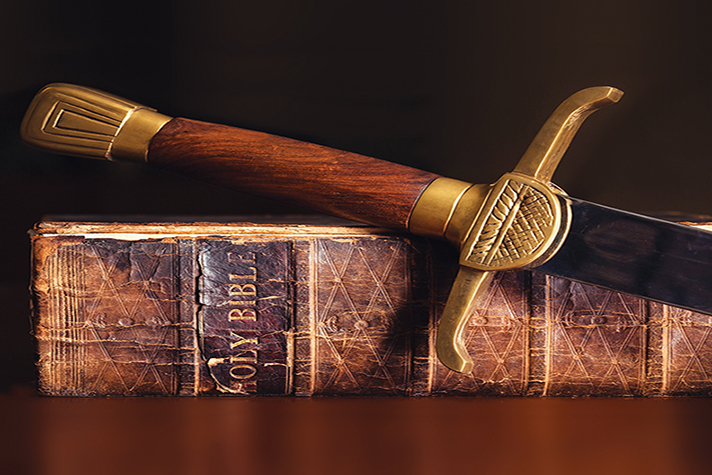
It would put us at a great disadvantage to see the Bible only as a book designed to bring cosmic comfort to the soul. To be sure, this is one of the things the Word of God does in the lives of all those who read it. But as we read the words of the prophet Jeremiah, the Bible also strikes its blow like a holy hammer, breaking a rock in pieces. And what is that rock? It is the rock of self-righteousness and sinful pride embedded in our own hearts.
The problem in too many pulpits today is that the preacher is more concerned with pleasing man than he is with pleasing God. Messages designed to tickle the ears and minister to felt needs are dominating the landscape. But when the whole counsel of God is preached, it comes with a holy hammer that chisels away at our sinful pride and self-righteousness, forming the image of our Lord Jesus Christ as time passes.
There are many false prophets who preach, “Peace, peace,” when there is no peace (Jeremiah 6:14). The natural man craves this false peace, for his greatest goal in life is to feel happy. But God desires so much more for His people! In God’s perfect plan for our imperfect lives, holiness — not happiness — is the path God intends for us to travel. And the pathway leading to holiness is not lined with peace, but persecution.
Here is a phrase I learned many years ago that I have repeated from the pulpit on many occasions: As a minister of the Good News of Jesus Christ, God has called me to comfort the afflicted and to afflict the comfortable. The Christian life is not designed to be lived safely within a zone of comfort, for comfort is not conducive to conformity to Christ.
Note well: The Bible’s blow is the believer’s blessing. Comfort must be mixed with challenge . . . peace must be mixed with pain. The Bible often uses sports metaphors to describe the life of the disciple of Christ. The runner will not reach his or her goal of winning the race without the discipline necessary to push through the pain and discomfort of training. The Word of God is designed to train us up in the way we should go, and that way is marked by weeping as much as it is marked by rejoicing — if not more so!
When was the last time the Word caused you to weep? When was the last time you felt the Bible’s blow hammering away at the old nature within? Remember, Jesus said it would be the truth that would set you free (John 8:32), and that truth is designed to turn your life inside out and upside down as God reshapes and redesigns His image in you.
This is the Gospel. This is grace for your race. NEVER FORGET THAT . . . AMEN!


 Grace for the Race