
Monthly Archives: September 2016

The Master and His Misfits

misfit toys

Because we are citizens of two kingdoms—the kingdom of God and the kingdom of man—we may very well feel, at times, like we just don’t “fit in.” The reason for this is the fact that both kingdoms operate on totally different value systems; because of this, we can feel like misfits from time to time. This is undoubtedly what the disciples felt when our Lord was crucified. Jesus had warned them:

I tell you the truth, you will weep and mourn while the world rejoices. (John 16:20)

Speaking to His disciples in the upper room on the night He was to be betrayed, Jesus told His disciples that He was about to be put to death, and that death would cause two diametrically opposed responses:

The world would rejoice and the disciples would weep and mourn.

The religious leaders rejoiced because they thought they had finally silenced that troublesome voice that many of the people were listening too. They believed God had vindicated their decision to crucify Jesus, because the Old Testament states that everyone hung on a tree is under God’s curse. Even Jesus Himself seemed to confirm this when He cried out from that cruel cross, “My God, My God, why have you forsaken me?”

Rome was rejoicing because they had removed a potential rabble-rouser from their midst. But while the world rejoiced, the disciples and all those who loved Jesus wept and mourned. They were the Master’s misfits.

Not much has changed after 2000 years. The world still rejoices at the things that make the people of God weep and mourn. The world rejoices when the name of Jesus is blasphemed. The world rejoices when the Law of God is disregarded. The world rejoices when sin is reduced to simply a matter of personal preference and every man does what is right in his own eyes. But the child of God weeps and mourns.

Yet after telling His disciples that they would grieve, Jesus made them a promise:

You will grieve, but your grief will turn to joy. (John 16:20)

When Jesus cried “It is finished!” and gave up His spirit, the world thought it had won a victory. But three days later, the grief of the disciples was turned into joy, because a dead man got up and walked out of His grave. Jesus overcame sin, Satan, and death through His crucifixion and resurrection, and it is this truth that will carry us through everything we are going through on this side of the grave. Jesus promised us that we would have trouble in this world, but He also said He has overcome the world (John 16:33). Our Master has overcome this world for His misfits . . . and that includes you and me!

Remember, weeping may last for a night, but joy comes in the morning (Psalm 30:5).

This is the Gospel. This is grace for your race. NEVER FORGET THAT . . . AMEN!
Leave a comment

Filed under General

Labor Day and Our Lord

labor day

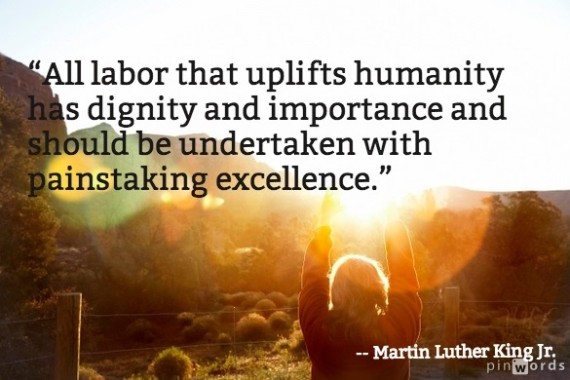
Labor Day is a United States federal holiday observed on the first Monday in September, which is meant to celebrate the economic and social contributions of workers. Today I would like to take a moment to celebrate the contributions of all workers who are busily engaged in building the kingdom of God.

It is important to ask and answer the question, “Who are the kingdom builders?” Is the term reserved only for those who are in full-time vocational service, such as pastors and missionaries? If you have been following our “Grace for the Race” blog for any length of time, you know that the answer to that question is a resounding “NO!”

Here are some profound words on this subject from Os Guinness, written in his book, The Call. This is an extended excerpt, but it is well worth reading and considering.

There is a great distortion which argues that Christ gave two ways of life to his church. One is the perfect life, the other is permitted. The perfect life is spiritual, dedicated to contemplation and reserved for priests, monks, and nuns; the permitted life is secular, dedicated to action and open to such tasks as soldiering, governing, farming, trading, and raising families. Higher vs. lower, sacred vs. secular, perfect vs. permitted, contemplation vs. action. Sadly, this two-tier or double-life view of calling flagrantly perverted biblical teaching by narrowing the sphere of calling and excluding most Christians from its scope. If all that a believer does grows out of faith and is done for the glory of God, then all dualistic distinctions are demolished. There is no higher/lower, sacred/secular, perfect/permitted, contemplative/active, or first class/second class.

Calling is the premise of Christian existence itself. Calling means that everyone, everywhere, and in everything fulfills his or her (secondary) callings in response to God’s (primary) calling. For the Reformers, the peasant and the merchant—for us, the business person, the teacher, the factory worker, and the television anchor—can do God’s work (or fail to do it) just as much as the minister and the missionary.

The recovery of the holistic understanding of calling was dramatic. William Tyndale wrote that if our desire is to please God, pouring water, washing dishes, cobbling shoes, and preaching the Word is all one. William Perkins claimed, “Polishing shoes was s sanctified and holy act and the action of a shepherd in keeping sheep, performed as I have said in his kind, is as good a work before God as is the action of a judge in giving sentence, or of a magistrate in ruling, or a minister in preaching.”

The cultural implications of recovering true calling were explosive. Calling gave to everyday work a dignity and spiritual significance under God that dethroned the primacy of leisure and contemplation. Calling gave to humble people and ordinary tasks an investment of equality that shattered hierarchies and was a vital impulse toward democracy. Calling gave to such practical things as work, thrift, and long-term planning a reinforcement that made them powerfully influential in the rise of modern capitalism. Calling gave to the endeavor to make Christ Lord of every part of life a fresh force that transformed churches and cultures. Calling gave to the idea of “talents” a new meaning, so that they were no longer seen purely as spiritual gifts and graces but as natural and a matter of giftedness in the modern sense of the term.

Calling demanded and inspired the transforming vision of the lordship of Christ expressed in the famous saying of the great Dutch prime minister, Abraham Kuyper: “There is not one square inch of the entire creation about which Jesus Christ does not cry out, ‘This is mine! This belongs to me!’”

WOW! Now that should help us all see the vision and value of calling from God’s perspective. From our first parents in the Garden of Eden, all of life is to be lived coram Deo (before the face of God). It doesn’t matter if one is a butcher, baker, or candlestick maker—or a priest, monk, or nun—every service is sacred when it is lived out in the light of eternity for the glory of God.

So . . . who are the kingdom builders for the King of kings and the Lord of lords? Here is the answer: Everyone who is putting their gifts, talents, and abilities into faithful service in order to glorify God and expand the cause of His kingdom.

This Labor Day, take a moment to do a personal evaluation in the area of your “calling” and ask yourself if there is any sacred/spiritual split. How is your work impacting the kingdom of God? How are you allowing God to use you, right were you currently are, to expand the cause of His kingdom?

So whether you eat or drink or whatever you do, do it all for the glory of God. 1 Corinthians 10:31)

I like to say that there is only one “menial” job in this world: that job is the one where Jesus cannot be found. If you labor as a labor of love for the glory of God, the good of others, and the expansion of God’s kingdom, you can rest assured that what you are doing—regardless of what others might think or say about it—echoes in eternity. Let that truth bless you this Labor Day!

This is the Gospel. This is grace for your race. NEVER FORGET THAT . . . AMEN!

Leave a comment

Filed under General

Liberty with Limits

boundaries

The Good News of the Gospel proclaims unimaginable liberty to us all. We have been liberated from hell. We have been liberated from the stranglehold that sin, Satan, and death once had on us. Tragically, however, many Christians foolishly believe that we are now free to live any way we choose, without any thought for consequences, very much like a teenager hurtling down the highway at twice the speed limit, recklessly confident that no harm will ever come to him or anyone else.

This notion is simply and utterly false! The liberty we enjoy as Christians comes with limits. The Scriptures lay out three classes of inspired instructions for the child of God:

#1. What God has commanded

#2. What God has forbidden

#3. What God neither commands nor forbids

Theologians sometimes refer to the third category— what God neither commands nor forbids—as “things indifferent,” and it is within this category that we must use discernment and prayerfully consider how we are to act. Our liberty must be lived out very carefully in these matters, always taking those within our circle of influence into consideration. Paul cautioned the Christians at Corinth:

Be careful, however, that the exercise of your rights does not become a stumbling block to the weak. For if someone with a weak conscience sees you, with all your knowledge, eating in an idol’s temple, won’t that person be emboldened to eat what is sacrificed to idols? So this weak brother or sister, for whom Christ died, is destroyed by your knowledge. When you sin against them in this way and wound their weak conscience, you sin against Christ. Therefore, if what I eat causes my brother or sister to fall into sin, I will never eat meat again, so that I will not cause them to fall. (1 Corinthians 8:9-13)

The apostle Paul was addressing a significant issue the Corinthians had hotly debated—whether or not to eat meat that has been sacrificed to idols. You’re probably thinking, “So what does that have to do with me? We don’t have that kind of ‘indifferent thing’ to be concerned about today.” That’s true, but we could very well substitute the question of whether or not a Christian should drink alcohol. Alcohol is not forbidden by Scripture; only drunkenness is prohibited. So, in our Christian liberty, we are free to drink a glass of wine with dinner . . . or a snifter of brandy after the meal. But what if we knowingly tempt or offend a weaker brother or sister in Christ by doing so?

Paul knew the Corinthians had the freedom to eat meat offered to idols, but he was careful to remind the “stronger” saints to be conscious of those weaker around them. The bottom line is this: our liberty must never lead another astray. The term for this principle comes under the heading of “The Royal Law of Love,” where our love for others trumps our liberty. The good of our more vulnerable brothers and sisters in the faith should be much more important to us than our liberty, because we are more concerned about contributing to their spiritual health than about exercising our freedom.

Here is a great way of looking at this issue: for the parents of newborn children, it is often the child who determines whether Mom and Dad will enjoy a “date night.” If the baby is sick or visibly terrified about being left with a sitter, the child rules the night and the parents stay home. When this happens, we don’t resent our baby; we simply respond to the child’s needs and go on with life. In the same way, you and I must not resent those around us who would be blessed by a bit of restraint in our lives.

The key is to always look outward, rather than inward, which is the foundation upon which our Gospel liberty has been given to us. Just two chapters later in the same epistle to the Corinthians, Paul said simply: “No one should seek their own good, but the good of others” (1 Corinthians 10:24).

The supreme example, of course, is found in the life of Christ. All liberty was within His possession, yet He laid down His liberty and His very life for us! Our salvation is not about us; it is about Jesus, and we must always be mindful of how we are putting the Gospel on display to a watching world.

As the nineteenth-century English novelist, poet, playwright, and politician, Edward George Bulwer-Lytton, once said, “Love sacrifices all things to bless the thing it loves.” This was the love that our Savior showed us; may this be the consistent confession of our liberated lives!

This is the Gospel. This is grace for your race. NEVER FORGET THAT . . . AMEN!

Leave a comment

Filed under General